|
Historical Information

The entrance into the St. Claire River from Lake Huron had long been
deemed of strategic importance. Named after General Charles Gratiot, the
engineer in charge of its construction, the Fort Gratiot military
outpost was established at the entrance to the river in 1814, and
ensured the security of vessels making the passage.With the surge in vessel traffic on Lake Huron in the early 1800's, the
need for a lighthouse to guide vessels into the river and away from the
shallows at the River entrance became a matter of increasing importance.
In response to this need, Congress appropriated $3,500 to construct a
lighthouse "near Fort Gratiot, in Michigan Territory" on March
3rd of 1823.
 The contract for construction of the lighthouse and keepers dwelling was
awarded to Captain Winslow Lewis of Massachusetts. Lewis was the
inventor of the patented Lewis Lamp, which the Fifth Auditor had
universally adopted as the primary source of illumination in the
nation's growing inventory of lighthouses. A staunch supporter and ally
of the Fifth Auditor, Lewis had branched out into the business of
lighthouse construction, and as the frequent low bidder, was being
awarded a growing number of contracts to fulfill the nation's need for
navigational aids on the East Coast. The contract for construction of the lighthouse and keepers dwelling was
awarded to Captain Winslow Lewis of Massachusetts. Lewis was the
inventor of the patented Lewis Lamp, which the Fifth Auditor had
universally adopted as the primary source of illumination in the
nation's growing inventory of lighthouses. A staunch supporter and ally
of the Fifth Auditor, Lewis had branched out into the business of
lighthouse construction, and as the frequent low bidder, was being
awarded a growing number of contracts to fulfill the nation's need for
navigational aids on the East Coast. Lewis sub-contracted the construction of the tower and keepers dwelling
that would become known as the "Fort Gratiot Light" to Mr.
Daniel Warren of Rochester New York. Work commenced on the structure,
but appears to have been running far beyond the scope of the original
bid, since Congress appropriated an additional $5,000 for
the project's completion on April 2, 1825. With the completion of construction on August 8th of that year, Fort
Gratiot Light held the honor of becoming the first lighthouse in the
State of Michigan.
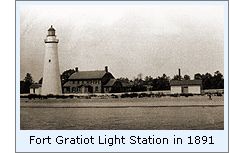 Rufus Match & Jean B. Denoyers served as temporary keepers until the
selection and appointment of a permanent keeper. The new tower stood 32
feet in height, with a diameter of 18 feet at the base, tapering to a
diameter of 9 ½ feet at its top. The lantern room was equipped with one
of the customary Lewis Lamp systems. George McDougall, a former Detroit
Lawyer of some ill repute was selected as the lights' first official
keeper, and arrived to take responsibility for the station in December
of that same year. Rufus Match & Jean B. Denoyers served as temporary keepers until the
selection and appointment of a permanent keeper. The new tower stood 32
feet in height, with a diameter of 18 feet at the base, tapering to a
diameter of 9 ½ feet at its top. The lantern room was equipped with one
of the customary Lewis Lamp systems. George McDougall, a former Detroit
Lawyer of some ill repute was selected as the lights' first official
keeper, and arrived to take responsibility for the station in December
of that same year.
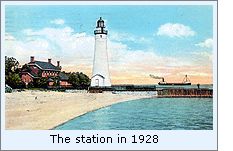 Even with the major cost overrun, it became quickly apparent that the
structure was both poorly designed and constructed. McDougall's reports
indicated that the stairs were so steep that they had to be climbed
sideways, and the trapdoor into the lantern room was barely large enough
for a man to squeeze through. While McDougall no doubt reported with
truth on this situation, it must be noted that he was reputedly a short
man with a weight in excess of 300 pounds, and as such hired an
assistant to perform all of his tower work! Even with the major cost overrun, it became quickly apparent that the
structure was both poorly designed and constructed. McDougall's reports
indicated that the stairs were so steep that they had to be climbed
sideways, and the trapdoor into the lantern room was barely large enough
for a man to squeeze through. While McDougall no doubt reported with
truth on this situation, it must be noted that he was reputedly a short
man with a weight in excess of 300 pounds, and as such hired an
assistant to perform all of his tower work!
During the summer of 1828, McDougall further reported that the tower was
cracking, and had begun to settle in such a manner that it was leaning
noticeably toward the East. Finally, reports from mariners indicated
that the tower was both poorly located and illuminated, since they found
that its' feeble light was virtually invisible until their vessels were
almost at the mouth of the River. As a result of continuing erosion at the foot of the tower caused by the
swift current in the river, the footings of the tower became so severely
undermined that the tower finally toppled to the ground during one of
Huron's infamous November storms in 1828. Congress acted swiftly, and on
April 2nd of 1829, appropriated $8,000 for the construction of a new,
improved lighthouse.
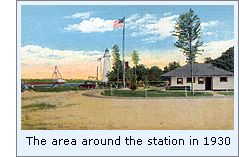 This time, the bid for construction was awarded to Lucius Lyons who was
the Deputy Surveyor General of the Northwest Territory at the time, and
would later go on to become one of Michigan's first US Senators. Lyons
crew began work immediately, and completed the reconstruction in
December of that same year. The new brick tower was 74 feet in height,
and 25 feet in diameter, and the lantern was once again outfitted with one of
the universal Lewis Lamp systems, which was fueled by whale oil, brought
in on the Erie Canal. This time, the bid for construction was awarded to Lucius Lyons who was
the Deputy Surveyor General of the Northwest Territory at the time, and
would later go on to become one of Michigan's first US Senators. Lyons
crew began work immediately, and completed the reconstruction in
December of that same year. The new brick tower was 74 feet in height,
and 25 feet in diameter, and the lantern was once again outfitted with one of
the universal Lewis Lamp systems, which was fueled by whale oil, brought
in on the Erie Canal.
 Soon
after its' establishment, the new US Lighthouse Board determined that
the Lewis Lamps universally accepted by the prior Pleasonton
administration were significantly inferior to the French Fresnel lenses
being adopted throughout the rest of the world. After conducting
successful trials of the new lenses in a few East Coast lights, the
Board decided to upgrade all lenses throughout the system. As a result,
the Lewis Lamps were removed from Fort Gratiot in 1857, and the tower
was refitted with a Fourth Order Fresnel
Lens, which had an
intensity of at least four times that of the old Lewis lamps. Soon
after its' establishment, the new US Lighthouse Board determined that
the Lewis Lamps universally accepted by the prior Pleasonton
administration were significantly inferior to the French Fresnel lenses
being adopted throughout the rest of the world. After conducting
successful trials of the new lenses in a few East Coast lights, the
Board decided to upgrade all lenses throughout the system. As a result,
the Lewis Lamps were removed from Fort Gratiot in 1857, and the tower
was refitted with a Fourth Order Fresnel
Lens, which had an
intensity of at least four times that of the old Lewis lamps.
As
lake shipping continued to rise dramatically in the early second half
of the century, it was determined that the Fort Gratiot Light needed
further upgrading. To this end, in 1861 the Government increased the
height of the tower to 82 feet, and the Fourth Order Fresnel was
replaced with a larger Third Order Lens, showing a fixed white light.
The old Fourth Order lens was taken to Saginaw and installed in the
Saginaw River Lighthouse.
 The growing amount of railroad traffic in Port Huron created
confusion for many mariners when the locomotive headlamps were seen to shine
as brightly as the Fresnel in the lighthouse. The problem was remedied
in 1867, when the "fixed white" lens at Fort Gratiot was swapped with the
"fixed
varied with a flash" lens from the Pointe Aux Barques light. The growing amount of railroad traffic in Port Huron created
confusion for many mariners when the locomotive headlamps were seen to shine
as brightly as the Fresnel in the lighthouse. The problem was remedied
in 1867, when the "fixed white" lens at Fort Gratiot was swapped with the
"fixed
varied with a flash" lens from the Pointe Aux Barques light.
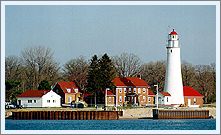
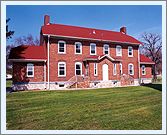
The original keepers dwelling was of wooden frame and clapboard
construction, and unfortunately burned to the ground in 1874. A brick
duplex was added to the site to provide quarters for the keeper and his
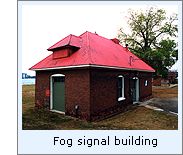
family along with the assistant keeper and his family. Fog signals have long been an integral part of the story at Fort Gratiot
Light. The first such unit was installed in 1871. A second steam-powered
diaphone fog signal unit was added in 1880, and both were replaced by a
steam-powered diaphone system housed in a brick building in 1901, which
still stands today.
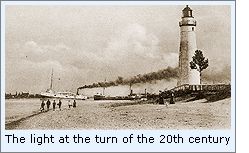
 The tower was again severely threatened during the great freshwater
hurricane of 1913, when it was almost washed from its foundation. After
weathering this storm within the tower, Captain Frank Kimball, the
keeper at the time, was quoted as saying "I watched waves as high
as 30 to 40 feet pounding on the lighthouse, and I think if the storm
had lasted another hour the lighthouse would have been wiped-out."
In order to help protect the foundation from such future poundings,
Kimball installed a three-foot high brick and mortar retaining wall
around the lake side of the tower the following year. This wall is still
standing today, and has become an integral feature of the tower
landscape. The tower was again severely threatened during the great freshwater
hurricane of 1913, when it was almost washed from its foundation. After
weathering this storm within the tower, Captain Frank Kimball, the
keeper at the time, was quoted as saying "I watched waves as high
as 30 to 40 feet pounding on the lighthouse, and I think if the storm
had lasted another hour the lighthouse would have been wiped-out."
In order to help protect the foundation from such future poundings,
Kimball installed a three-foot high brick and mortar retaining wall
around the lake side of the tower the following year. This wall is still
standing today, and has become an integral feature of the tower
landscape.
In 1933 the tower was outfitted with a green
DCB-24 Aerobeacon,
and was completely automated. With a range of 18 miles, the DCB-24
exhibited a one half second flash in every 15 seconds. The optic has
now been changed to a Vega rotating beacon which exhibits a similar
characteristic. The
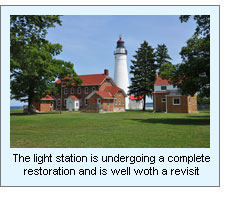
five acre lighthouse grounds and all associated buildings were
transferred to St. Clair County through the National Historic
Lighthouse Preservation Act in 2010. The county entered into a
partnership with the Port Huron Museum, and the partners began
restoration in 2011.

Keepers of
this Light
Click here
to see a complete listing of all Fort Gratiot Light keepers compiled by
Phyllis L. Tag of Great Lakes Lighthouse Research
Seeing this Light
The
light station grounds are open to the for
public throughout the summer season with tours of the tower
and station buildings scheduled throughout the day. Information on
open hours and programs available on the Port Huron Museum website here
or by telephoning 810-982-0891.
|