|
Historical Information

 As freighters plying the St.
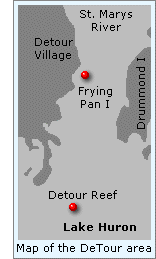
Marys River grew in length and depth, a reef lying 24 feet below the surface off
the entrance to the river between Detour Point and Drummond Island became a
menace to safe passage between the lake and river. Without funding to erect a lighthouse,
an acetylene buoy was placed to mark the reef on September 29, 1897 as a
temporary measure. As freighters plying the St.
Marys River grew in length and depth, a reef lying 24 feet below the surface off
the entrance to the river between Detour Point and Drummond Island became a
menace to safe passage between the lake and river. Without funding to erect a lighthouse,
an acetylene buoy was placed to mark the reef on September 29, 1897 as a
temporary measure. As part of a major project to
improve aids to navigation in the Straits of Mackinac at the end of the 1920’s,
the Lighthouse Bureau had proven its ability in the efficient construction of
offshore crib-based lights at Martin Reef in 1927, and Poe Reef 1929. With success
already in its back pocket, after receiving an appropriation for the
construction of a first-class light station on Detour Reef, the Bureau was immediately
able to focus its attention on construction of the new station. 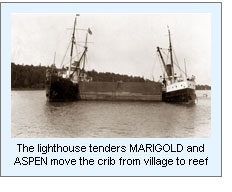 The first order of business was
the establishment of a land-based camp as close as possible to the reef. Here,
the crib which would form the submarine foundation for the structure could be built,
and housing could be obtained for the construction crew. By the twin virtues of
having deep water close to its shore and its proximity to the construction
site, Detour Village was selected as the best location for the base of
operations. The first order of business was
the establishment of a land-based camp as close as possible to the reef. Here,
the crib which would form the submarine foundation for the structure could be built,
and housing could be obtained for the construction crew. By the twin virtues of
having deep water close to its shore and its proximity to the construction
site, Detour Village was selected as the best location for the base of
operations.
With the base site selected, work
began simultaneously at Detour Village and on the reef itself.
At the village, the
massive 60-foot square, 20-foot high timber crib was constructed of 12"
square timbers on a skid-way down which it would eventually slide into the
water. On the reef, hard-hat divers worked with a scow equipped with a crane
system to clear and level an area in 24 feet of water where the crib would
eventually be placed. With the site on the reef prepared, the crib was pulled down
the greased skid-ways into the water, and the lighthouse tenders MARIGOLD and ASPEN
attached lines and carefully guided the huge structure away from shore and out
to the reef. 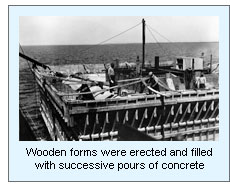 Arriving at the reef, the crib
was carefully centered on the cleared and leveled area, and ballast pockets
built into the crib were filled with crushed limestone delivered by freighters
and transferred into the crib with the assistance of the scow's conveyor.
Eventually overcoming its natural buoyancy, the crib sank on the prepared
bottom in its prepared location. The entire center section of the crib was then
filled with crushed stone, and the outer walls filled with cement using the Tremie
method in order to provide support to the exterior timbers, which as a result
of their submerged condition would remain free of rot virtually for eternity. Arriving at the reef, the crib
was carefully centered on the cleared and leveled area, and ballast pockets
built into the crib were filled with crushed limestone delivered by freighters
and transferred into the crib with the assistance of the scow's conveyor.
Eventually overcoming its natural buoyancy, the crib sank on the prepared
bottom in its prepared location. The entire center section of the crib was then
filled with crushed stone, and the outer walls filled with cement using the Tremie
method in order to provide support to the exterior timbers, which as a result
of their submerged condition would remain free of rot virtually for eternity.
 Wooden forms were then erected
atop the crib, and the work of filling the forms with successive pours of
concrete from a mixer aboard the scow began. As the pour continued, a large central
open area and smaller peripheral storage areas were cast into the concrete. With
the pouring of the curved wave apron, work on the crib was complete and the
upper surface of the pier was carefully smoothed to create a level foundation
for the lighthouse structure itself, which was to be erected at the exact
center of the pier. By the end of the 193o season, work on the pier was
virtually complete and a temporary light was placed atop the pier deck,
allowing the removal of the gas buoy. Wooden forms were then erected
atop the crib, and the work of filling the forms with successive pours of
concrete from a mixer aboard the scow began. As the pour continued, a large central
open area and smaller peripheral storage areas were cast into the concrete. With
the pouring of the curved wave apron, work on the crib was complete and the
upper surface of the pier was carefully smoothed to create a level foundation
for the lighthouse structure itself, which was to be erected at the exact
center of the pier. By the end of the 193o season, work on the pier was
virtually complete and a temporary light was placed atop the pier deck,
allowing the removal of the gas buoy.
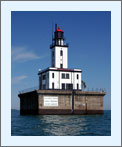
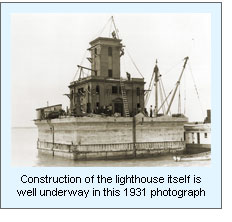
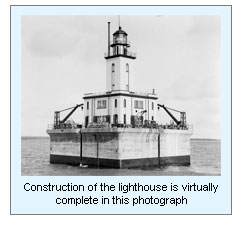 Construction of the building
used the state of the art methods proven in skyscraper construction, consisting
of a central skeletal support structure of I-beams faced with an exterior of
iron and steel, lined with an insulating layer of masonry. Electrical power for
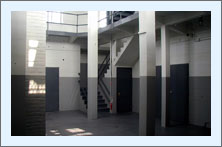
the lighthouse was provided via a submarine cable from Detour Point. The large open
area in the center of the concrete pier extended up into the first level of the
structure, and served to house the compressors which provided air for the station’s
F2T diaphone, stand-by generators and the station’s hot water heating plant. Construction of the building
used the state of the art methods proven in skyscraper construction, consisting
of a central skeletal support structure of I-beams faced with an exterior of
iron and steel, lined with an insulating layer of masonry. Electrical power for
the lighthouse was provided via a submarine cable from Detour Point. The large open
area in the center of the concrete pier extended up into the first level of the
structure, and served to house the compressors which provided air for the station’s
F2T diaphone, stand-by generators and the station’s hot water heating plant.
In order to reduce construction
cost, the lantern, stair cylinder, spiral stairs and Third-and-a-half Order Fresnel
lens from the old 1861 Detour Point light were disassembled, cleaned and shipped to
the new light and reassembled atop its square central tower. Work was finally completed in the late fall of
1931, with the light officially exhibited from the new tower on the night of November
10, 1931. 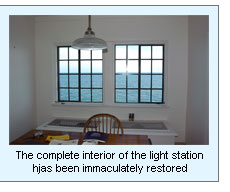 In 1998, a group of community leaders from DeTour Village and Drummond
Island met to form the DeTour Reef Light Preservation Society (DRLPS), a
non-profit volunteer 501(c)(3) organization and began planning the restoration of
the lighthouse. After obtaining a series of grants to fund the restoration, the
group enlisted the services of UP Engineers and Architects and contractor
Mihm Enterprises to undertake the full restoration of the light station over 2003
and 2004. In 1998, a group of community leaders from DeTour Village and Drummond
Island met to form the DeTour Reef Light Preservation Society (DRLPS), a
non-profit volunteer 501(c)(3) organization and began planning the restoration of
the lighthouse. After obtaining a series of grants to fund the restoration, the
group enlisted the services of UP Engineers and Architects and contractor
Mihm Enterprises to undertake the full restoration of the light station over 2003
and 2004.
The restoration of the Detour
Reef Light stands as an amazing example of the incredible success which can be
obtained by a local grass-roots group of motivated preservationists, with the
group receiving numerous awards and public acclaim for their wonderful efforts
over the ensuing years.

Keepers of
this Light
Click here
to see a complete listing of all DeTour Reef Light keepers compiled by
Phyllis L. Tag of Great Lakes Lighthouse Research.
Seeing This Light
The
Detour Reef light is located far enough out in Lake Huron
that only distant views can be obtained from shore. The Detour
Reef Light Preservation Society offers both live-in volunteer
keeper opportunities and boat trips out for full tours of
the light station on weekends throughout the summer season. For
further
information click here
to visit the Society's website, email them at drlps@drlps.com or write them at: DeTour Reef Light Preservation Society
PO Box 307
Drummond Island, MI 49726
|